DAMMAM · 2ND INDUSTRIAL CITY · الدمام · المدينة الصناعية الثانية YARD OPEN SUN–FRI 06:00–19:00 +966 53 571 7201 · WHATSAPP

NEWS · الأخبار

The state of Saudi recycling.

Industry briefs from the people doing the work: what the Kingdom is building, what it is diverting from landfill, and what that means for anyone holding metal.

01The weight you watchCERTIFIED SCALE, PHOTOGRAPHED02Prices that holdAGREED IN WRITING, FIRST03Money that arrivesWITHIN SEVEN DAYS, EVERY TIME04Spoken your wayENGLISH · العربية · اردو · বাংলা · हिन्दी · TAGALOG · മലയാളം
№ 01

Industry briefs.

موجزات الصناعة

Written at the yard, checked against the public record.

POLICY·AUGUST 2026

The Kingdom has decided its waste is worth money.

Saudi Arabia’s National Waste Management Strategy is one of the most ambitious in the world: divert 82% of all waste away from landfill by 2035. That includes 100% of municipal waste, 60% of construction and demolition waste, and 85% of industrial waste. The National Center for Waste Management (MWAN) writes the rules; the Saudi Investment Recycling Company (SIRC), a PIF company, is building the infrastructure to meet them.

The numbers behind the policy are industrial, not decorative: the program is expected to contribute around $10 billion to GDP, create some 23,000 direct jobs, and cut CO₂ emissions by 13 million tonnes.

What it means on the ground: metal sitting in Eastern Province workshops and warehouses stops being an afterthought and becomes a regulated, priced, documented supply chain. The companies that thrive will be the ones that can prove where every tonne went. That is the way canasa has run its scale from day one.

SOURCES · MWAN NATIONAL WASTE STRATEGY · SIRC · VISION 2030

Crushed and baled scrap metal cubes stacked for recycling
BALED SCRAP, READY FOR THE MILL

CONSTRUCTION·AUGUST 2026

A trillion-dollar build-out sheds metal at every stage.

Between NEOM, Qiddiya, the Red Sea destinations, Riyadh’s Mukaab and metro expansions, and a planned network of 59 logistics zones, Saudi Arabia has committed more than $1.5 trillion of construction. Structural steel demand is running at near-record levels, and the Kingdom’s steel market is forecast to keep growing through 2034.

Every one of those sites sheds metal the whole way up: rebar tails and plate offcuts, formwork and temporary steel, cable drums, packaging, and the demolition of whatever stood there before. Under the national strategy, 60% of construction and demolition waste must be diverted from landfill, a rule that quietly turns recovery contractors into part of project delivery rather than a skip at the gate.

For contractors, the practical takeaway is written into canasa’s projects model: recovered metal has real value, that value can offset project cost, and the paperwork proving it survives the audit.

SOURCES · VISION 2030 PROJECT PIPELINE · SAUDI STEEL MARKET REPORTS

Structural steel arches of an industrial building under construction
STRUCTURAL STEEL GOING UP

E-WASTE·AUGUST 2026

The richest ore in Saudi Arabia sits in office drawers.

The Kingdom is the largest generator of electronic waste in the GCC, at roughly 620 million kilograms a year, of which about 85% still ends up in landfill. On current trends the figure passes a billion kilograms a year by 2030. Circuit boards carry gold, silver and copper at concentrations a mine would envy, and the region’s e-waste economy is forecast to grow from about $1.6 billion today to nearly $7 billion by 2035.

Policy is moving the same direction: MWAN’s targets call for over 90% of e-waste to be reused or recycled by 2035, with special handling for batteries and data-bearing devices.

For businesses, the metal is only half the story. Servers and drives leave with your data on them. That is why canasa handles e-waste with itemised intake lists, sealed transport on request, and destruction documentation for every drive. The custody paper is the product.

SOURCES · MWAN · GCC E-WASTE MARKET STUDIES · KFUPM RESEARCH

Macro photograph of a gold printed circuit board
GOLD TRACES ON A RECOVERED BOARD

FROM THE YARD·AUGUST 2026

Why the weighbridge is the whole business.

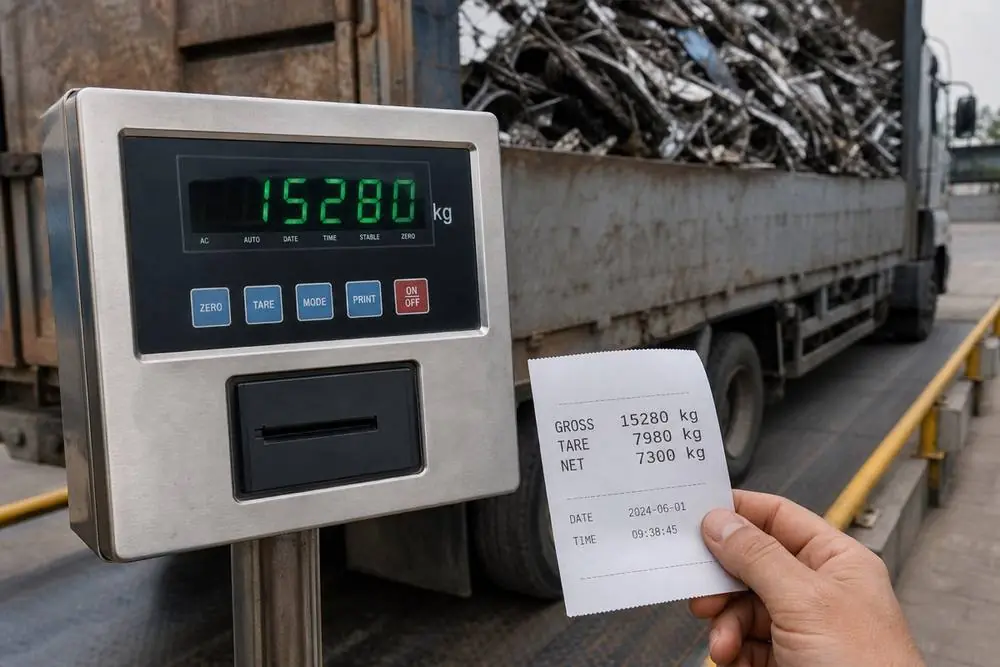
Everything this industry promises, from fair prices to honest grading to money that arrives, resolves at one machine. A certified weighbridge doesn’t negotiate, doesn’t round in anyone’s favour, and doesn’t forget. That is why canasa’s scale sits where every seller can watch it work.

A weigh ticket worth keeping has four things on it: a photographed weight, the grade you were shown and told why, the price that was agreed before the truck moved, and a settlement date. If any of the four is missing, you are not holding a document. You are holding a story.

As the Kingdom’s targets turn recycling into a regulated market, that piece of paper stops being a courtesy and becomes the industry’s currency. Bring one load through our gate in Dammam’s Second Industrial City and judge the ticket for yourself.

CANASA · 2ND INDUSTRIAL CITY, DAMMAM · SUN–FRI 06:00–19:00

Grab crane sorting metal above baled scrap at a recycling yard
SORTING LINE AT A RECYCLING YARD